

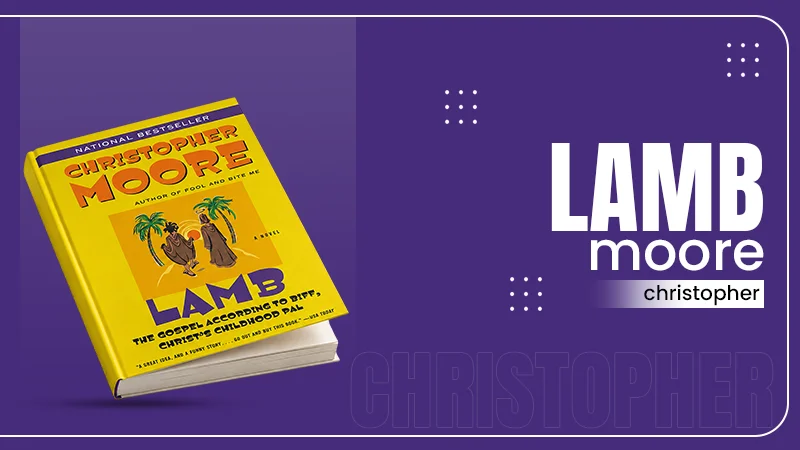
Lamb by Moore Christopher is an absolute masterpiece of historical and satirical fiction with a punch of absurdist humour. Published in 2002, Lamb: A Gospel According to Biff, Christ’s Childhood Pal is a satirical reimagining of the first 30 years of Jesus’ life, largely absent from the biblical account.
The novel received the American Library Association’s Best Books for Young Adults award in 2003. Combining humor, friendship, adventure, and fictional storytelling, it is a quick-witted and humorous read, making it an unconventional yet engaging novel. If you love satire and humour, then read this lamb Moore Christopher review to learn more about this novel.
TRIGGER WARNING!
The novel contains gruesomely violent scenes, miscarriages, suicides, prostitution, and homicide.
| Title of the Book | Lamb: A Gospel According to Biff Christ’s Childhood Pal |
| Author | Christopher Moore |
| Genre | Satirical Fiction/Absurdist Humour |
| Language | English |
| Published Year | 2002 |
| Print Length | 464 pages |
| Language | English |
| Price Range | INR 1,300 to INR 1,400 |
| Total Reading Hours | 22-24 hours |
| Main Themes | Religion, Faith, and Humanity |
| Prizes Won | American Library Association’s Best Books for Young Adults award in 2003 |
| Get Your Copy | Amazon |
| My Ratings | 4.5/5 |
- Lamb: The Book of Biff: A Quick Synopsis
- The Opposite Protagonists of the Novel Lamb: Biff and Joshua
- Themes in Christopher Moore’s Novel: Lamb: A Gospel According to Biff, Christ’s Childhood Pal
- Christopher Moore’s Writing Style in the Novel Lamb
- What I Liked and What I Didn’t Like About the Novel Lamb By Christopher Moore
- What Didn’t Work Well in Lamb: My Thoughts and Criticism
- My Favourite Quotes From the Novel Lamb by Christopher Moore
- Other Notable Works You Must Read If You Enjoyed Reading Lamb
- Final Verdict: Is The Lamb Book of Biff Worth Reading?
- Frequently Asked Questions (FAQs)
Lamb: The Book of Biff: A Quick Synopsis
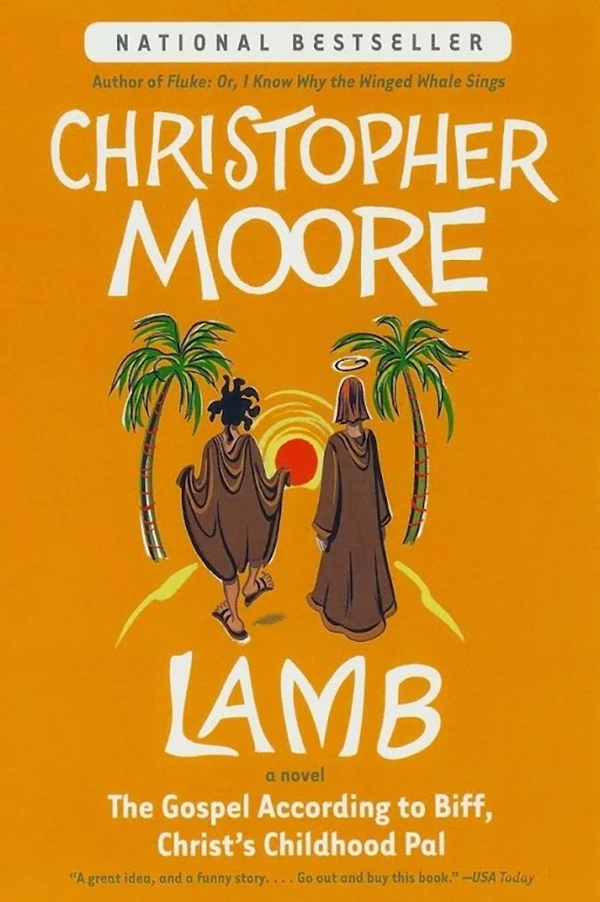
Christopher Moore’s Lamb: A Gospel According to Biff, Christ’s Childhood Pal, is a satirical account of the first 30 years of Christ’s life (here referred to as Joshua), largely absent from biblical narratives. The story moves back in time 2000 years, when Biff, Joshua’s childhood pal and raconteur, is resurrected by Angel Razie to record Joshua’s lost years in a language other than Aramaic.
The novel begins with Biff and Joshua growing up in Nazareth. At the beginning, Biff is an ordinary Jewish boy; his life takes an unexpected turn when he meets Joshua, the future messiah, at the age of six. Growing up together, Biff witnesses the magical powers of Joshua, such as befriending a deadly snake and awakening a dead woman; however, it takes a humorous turn when both involve themselves in a series of unusual and humorous adventures, such as castrating Apollo’s statue.
The friendship deepened as both fall in love with the same woman, Mary Magdalene, whom they eventually left behind as they embark on a fourteen-day journey to seek enlightenment, only to find Biff hilariously distracted by the earthly pleasures of harlots. On their journey through China and India, the two encounter different philosophies and traditions, discovering sinful things and learning meditation and martial arts.
Also Read: Must-read books of all time
The Opposite Protagonists of the Novel Lamb: Biff and Joshua
Joshua and Biff are the polar opposite characters in the novel, being emotional anchors to each other on their adventure-packed journey towards enlightenment.
1. Joshua
Character Traits: Kind, Compassionate, Divine, Healer, and Spiritual.
Joshua, the son of god, is the divine counterpart to Biff. Described briefly as someone with eyes “like dark honey” and “blue-black curls”, Joshua’s character has an interesting portrayal, a mix of divine spirit and equally human persona.
As the novel begins, Joshua, a six-year-old child, is busy bringing a lizard back to life, establishing his role as a saver, protector, and the merciful, bringing life and healing to the world.
However, as the novel progresses, his innately human side is brought forth by portraying him as a young man, ambiguous about his vocation, and facing self-doubt about his capabilities. He’s constantly searching his way through the world, learning different philosophies, arts, and cultures, in contrast to his best friend Biff, on his way to uncover sin, sarcasm, and lust.
2. Biff
Character Traits: Lustful, Trouble Maker, Sarcastic, Quick-Witted
Biff is Joshua’s irrelevant childhood friend, or rather, relevant, because he serves as the emotional anchor throughout the novel, balancing the yin with yang, and spiritual with carnal. He is the worldly counterpoint, sarcastic, witty, a rabble-rouser and lustful. As a normal Jewish boy, his journey with Joshua is marked by absurd adventures, poking, castrating the statues, understanding Kama Sutra, preoccupation with harlots and concubines, dancing, and whatnot!
His innate human reactions and experiences become even more interesting when he invents sarcasm and learns sinning, comically as a “favour to the Christ”, to better understand the sin of lust. The best part about his characterisation is to keep Joshua grounded and his virtue and merit in check. Biff constantly feels skeptical of what Joshua says and does, while openly being scornful of anyone trying to offer One Truth.
Themes in Christopher Moore’s Novel: Lamb: A Gospel According to Biff, Christ’s Childhood Pal
The novel Lamb is one of the best portrayals of religion and its dogmas. It delves into various themes, such as the use of humour and satire, religion, faith, and humanity. Here’s what stood out to me:
1. Humor and Satire
Ratings: ⭐⭐⭐⭐
Although the novel satirizes religion, it does not construct a disrespectful parody of Christianity. Moore uses sharp wit and creates subject matter that is very well researched in terms of its practices, cultures, and norms. By portraying Jesus as a normal human, a person who is a Son of God but has no idea about it, he seems as confused as Biff, a very irrelevant human being.
The perspective of Biff adds an almost crude narrative that strips away the holiness of Jesus and replaces it with rather teenage banter. However, the use of this humour has received a fair share of appreciation and criticism, being called “frat-humour”; the author rather wants to portray it as adolescent humour.
2. Religion, Faith, and Humanity
Ratings: ⭐⭐⭐⭐⭐
The novel portrays two contrasting characteristics of religion through Biff, Joshua, and his lost years. While Joshua learns from the three wise men about their philosophies and religions- Hinduism, Taoism, and Buddhism- Biff rather focuses on learning the art of creating weapons, killing with a touch, martial arts, how to charm women, and the Kama Sutra.
Moreover, the portrayal of three men is peculiarly interesting (Gasper, Balthazar, and Melchior). Although these three “wise men” are the proponents and masters of religion, they are comically reduced to someone “chasing yeti”, allowing their characterisation to fit the absurd narrative tone. These incidents satirize religion, offering counterpoints through lustful and irrelevant Biff and the spiritual leader Joshua.
Christopher Moore’s Writing Style in the Novel Lamb
Lamb by Christopher Moore is known for its witty and sarcastic writing style. The tone and narrative style are a perfect mix of humour, sarcasm, wit, modern slang, and pop-culture references with religion and well-researched biblical events. The best part is that despite being humorous, the narrative does not disrespect culture or religion; rather, it urges the audience to ask difficult philosophical and theological questions.
Readers Who Will Enjoy Reading Lamb by Christopher Moore:
- Fans of humour and satire
- Readers Who Like Exploring Socio-Political Concerns
- Fans of Absurdist Humour, Philosophy, and History
- Fiction Lovers
Readers Who Might Not Enjoy Reading This Novel:
- Devout Believer
- Sensitive Audience
- Fans of Dry and Subtle Humour
What I Liked and What I Didn’t Like About the Novel Lamb By Christopher Moore
Although the novel Lamb is one of the best works by Christopher Moore, the novel has received its own share of criticism and appreciation.
Here’s what I liked and did not like about Lamb the book of Biff:
1. What I Liked About the Novel
Here’s what I really enjoyed about this novel:
- Witty and Intelligent Dialogues
- Sarcasm and Humour
- A Perfect Blend of Entertainment and Intellect
- The Travelogue Structure
- Unusual Pairing of Biff and Joshua
2. What I Did Not Like About the Novel
- Racist and Sexual Jokes
- Dehumanizing Aspect in a Travelogue
- Orientalism
What Didn’t Work Well in Lamb: My Thoughts and Criticism
Although some aspects of the novel are not meant to be taken literally, I believe some parts should have a sincere and apt portrayal. Here are those aspects which I did not enjoy thoroughly.
1. Orientalism
One aspect of the novel that did not work for me was the way it portrays Chinese characters, almost from an oriental viewpoint, reducing Chinese culture to exaggerated stereotypes viewed negatively through a Western lens. On their visit to Balthasar, they discovered that Balthasar had eight Chinese concubines, named like “Tiny Feet of Divine Dance of Joyous Orgasm”, and more, which is sexist and dehumanising.
This issue becomes more apparent when Biff admits that he and Joshua have shortened these eight names because pronouncing them in Chinese sounded like “throwing a bag of silverware down a flight of stairs (ting, tong, yang, wing, etc).” While this may be used as comic relief, for me, this humour didn’t quite land; instead, it feels dehumanising and unnecessarily stereotypical.
Personally, it felt that a large part of the humour was dependent on making Asian culture exotic and mysterious spaces of wisdom, spirituality, and sexual temptation. Although this could be intended satire, for me, it quite doesn’t neutralise the stereotype it reproduces as a reader.
2. The Ambiguous Pairing of Biff and Joshua
I couldn’t make out why the novelist paired two polar opposite characters together: Joshua, the spiritual and compassionate student, and Biff, the sensual, messy, and insanely human counterpoint to divine Joshua. As the story progresses, I found myself wondering what Moore wants to accomplish with this pairing.
Is Biff just comic relief against sincere Joshua? Are they meant to represent the dichotomy of human and divine, a presentation of messy humans alongside messiahs? Is this contrast meant to explore the two different approaches to life: the morally right and wrong?
This ambiguity is prevalent throughout the novel during their spiritual journey. For example, during their visit to India, Joshua, being a sincere student, immerses himself in learning Hinduism, meditation, and yoga, while Biff focuses on the Kama Sutra. Similarly, in China, Joshua focuses on learning philosophies; Biff is preoccupied with concubines and harlots.
The contrast is undoubtedly entertaining to watch, but it lacks depth. Personally, as a reader, I wished the novel explored this relationship more explicitly. For me, it’s just Biff keeping Joshua connected to the imperfections of life, and Joshua offering Biff a spiritual and divine intervention.
My Favourite Quotes From the Novel Lamb by Christopher Moore
Here are some of my favourite quotes from the novel Lamb: A Gospel According to Biff:
- “Blessed are the dumbfucks.”
- “If you think anyone is sane, you just don’t know enough about them.” — Biff
- “That’s the difference between irony and sarcasm. Irony can be spontaneous, while sarcasm requires volition. You have to create sarcasm.”
- “Routine feeds the illusion of safety…”
- “You think you know how this story is going to end, but you don’t.”
- “This story is not and never was meant to challenge anyone’s faith; however, if one’s faith can be shaken by stories in a humorous novel, one may have a bit more praying to do.”
- “Unless you can change the past, you’re wasting the present on this guilt”
Other Notable Works You Must Read If You Enjoyed Reading Lamb
If you enjoyed reading Moore’s humour and satire in Lamb the book of Biff, then here are some other books worth considering:
| S No. | Books | Why You Should Read This |
| 1. | Fool: A Novel | Fool by Christopher Moore is a witty retelling of Shakespeare’s King Lear. |
| 2. | Sacre Bleu | Known for its absurdist themes, it’s an art-history comedy mystery involving Vincent Van Gogh. |
| 3. | Small Gods | Small Gods by Terry Pratchett is a philosophical satire about a god who returns to Earth as a small tortoise. |
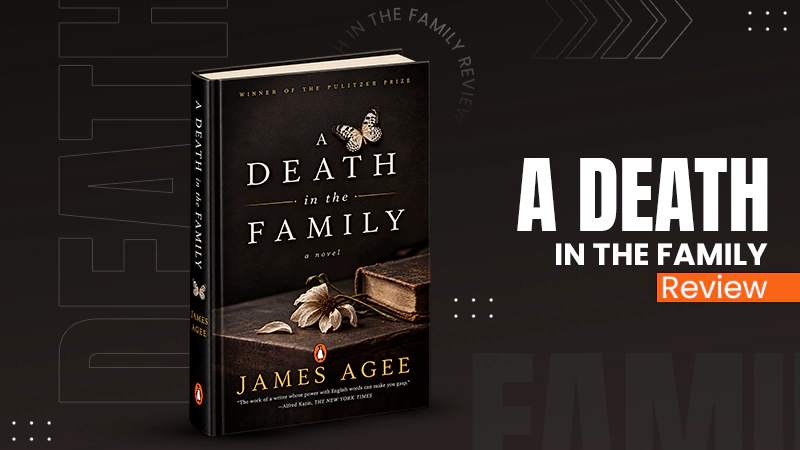
| 4. | A Death in the Family | A Death in the Family by James Agee is a semi-autobiographical novel about love, loss, family, and death. |
Final Verdict: Is The Lamb Book of Biff Worth Reading?
Yes, the novel Lamb by Christopher Moore is definitely a must-read novel. Not only does it challenge the idea of Christianity as a religion and the dogmas associated with it through satire and humour, but it’s also ahead of its time with ideas that still resonate today.
Through Biff and Joshua, you can see a contrasting nature of humanity, faith, and religion, which makes it a worthwhile read. It challenges the idea of One Truth, and rather encourages readers to challenge the norms and own their truth. Personally, I felt that this novel is a perfect mixture of humour and philosophy, allowing readers to ponder over difficult theological and philosophical questions, making it one of my favourite reads.
Frequently Asked Questions (FAQs)
Is Lamb a good book?
Yes, Lamb by Christopher Moore is a must-read novel if you enjoy humour, satire, and philosophical and theological questions. The novel significantly challenges the idea of religion, allowing the audience to challenge the norms and uncover the truth.
What is Lamb by Christopher Moore about?
Lamb by Christopher Moore is a comical and satirical novel tracing the “lost” years of Christ from the perspective of his childhood friend Biff, resurrected by an angel in modern times to write a gospel, including details about Christ’s youth, his study of Eastern philosophy, and deep human friendship.
What is Christopher Moore’s most popular book?
Lamb: A Gospel According to Biff Christ’s Childhood Pal is one of the most famous and most-reviewed books by Christopher Moore. It traces the record of “lost” years of Jesus from the perspective of his friend, Biff.
Which Christopher Moore book should I read first?
Although there is no particular order for reading Moore’s books, you can begin by reading his most acclaimed novel, Lamb. Other recognised standalone novels worth reading include Coyote Blue, Island of Sequined Love, Nun, and Anima Rising.